If you have ever fallen in love with a piece of land in Stephens County, you know how easy it is to picture the house before you know whether the lot can actually support it. That is where many buyers get tripped up. When you understand the right checks to make before closing, you can avoid costly surprises and move toward your future home with more confidence. Let’s dive in.
Why buildability comes first
In Stephens County, buying land for a future home is about more than size, views, or road frontage. Because the county sits in the foothills of the Blue Ridge Mountains, slope, drainage, access, and utility availability can all shape whether a parcel works as a homesite.
Before you think too much about floor plans, focus on a simpler question: can this land legally and physically support a house, driveway, utilities, and wastewater disposal? That one question can save you time, money, and frustration later.
Start with boundaries and legal description
A listing sheet or county map can give you a helpful first look, but it should not be the final word on property lines. Stephens County notes that its GIS is useful for preliminary information like acreage, roads, utilities, and hydrologic features, but it is not a substitute for a survey.
The county also notes that its cadastral mapping has positional accuracy of about 2 feet. For raw land, that matters. Before closing, you should verify the deed, easements, and exact boundary lines with a licensed surveyor.
Why a survey matters
A current survey can help you confirm where you can place a driveway, home site, septic area, and other improvements. It can also reveal issues that are easy to miss early on, such as encroachments, irregular access, or easements that affect how you use the land.
If the tract came from a larger parcel or subdivision, recorded plats matter too. Stephens County requires plats to be filed electronically through the Georgia Superior Court Clerk’s Cooperative Authority, so it is smart to verify that the recorded plat matches the legal description of the property you plan to buy.
Check flood risk and drainage early
In rural land purchases, water can shape cost just as much as price per acre. Low spots, streams, and drainage paths may affect where you can build, where you can install septic, and how you design the driveway.
FEMA’s Map Service Center is the official source for flood hazard information. You should confirm whether the proposed homesite, driveway, or septic area falls within a mapped flood zone before you move too far forward.
Stephens County GIS can also help you identify streams, rivers, lakes, and other hydrologic features early in the process. That first review can help you spot possible wet ground or drainage concerns before you invest in deeper due diligence.
Review soils before you fall in love
Soils are one of the biggest factors in whether rural land can support a future home. The USDA NRCS Web Soil Survey is the official soils tool, and the agency notes that soil surveys can help evaluate septic absorption fields, foundations, and other land-use limits.
That means soil screening should happen early, not after closing. A beautiful tract may still present challenges if the soils, groundwater, rock, or absorption conditions do not support your intended use.
Septic approval is not automatic
If the lot will need a septic system, Georgia Department of Public Health rules require a county health department site inspection before an onsite sewage construction permit can be issued. That inspection looks at soil, groundwater, rock, and absorption conditions.
Just as important, a favorable result is not an open-ended approval. Septic permits are valid for no more than 12 months. If a property will rely on septic, you should factor that timing into your planning.
Confirm water service options
One of the most practical questions for any Stephens County land purchase is whether public water is available. Stephens County’s newcomer information states that the county does not provide water service, and the City of Toccoa handles water service for the area.
Because the city system serves Toccoa, Stephens County, and beyond, some parcels may be able to connect. Others may not. You should confirm parcel-specific availability before closing rather than assuming service is close enough to be simple.
What if the property needs a well?
If public water is not available, a private well may be the path forward. Georgia DPH recommends annual bacterial testing and chemical screening every three years for private wells.
The state also says wells should be kept away from contamination sources such as septic systems and surface runoff. That makes site layout important from the beginning, especially on rural or sloped property.
Verify power, gas, and internet
Utilities can vary a lot from one parcel to the next, even within the same area. Stephens County lists Georgia Power and Hart EMC for electric service, Toccoa Natural Gas for gas, and Windstream, TruVista, and North Georgia Network for phone and internet options.
That list gives you a starting point, but it does not replace parcel-level confirmation. Before you buy, ask what is actually available at the site and what extensions or installation costs may be required.
Road access can change everything
A land purchase can look straightforward until you study how you actually get to the future homesite. In Stephens County, road access is one of the most important items to verify because driveway work, drainage requirements, and maintenance responsibility can all affect your budget.
Stephens County states that it only maintains roads where it has county right-of-way or easement rights. If a parcel sits on a private road or private easement, maintenance and improvements may be your responsibility.
Driveways need approval too
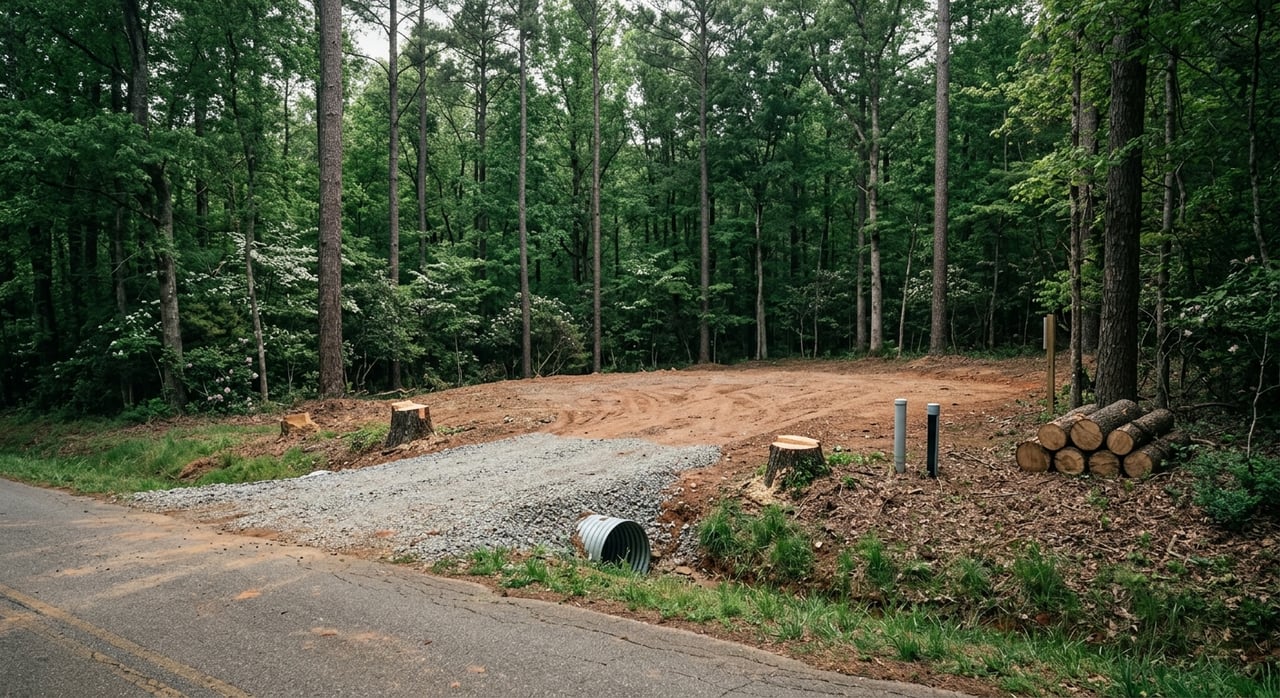
The county’s residential driveway guidelines place responsibility on the owner or developer to buy and install driveway pipe. The county also requires inspection and approval.
Those guidelines also state that drainage from new driveways should be directed away from the county roadway. In hilly terrain, that is not a minor detail. Grading and drainage design can become a real cost item.
State highway frontage has another step
If the parcel fronts a state highway, there is a different approval path. Georgia DOT requires a permit before work happens in the state highway right-of-way, including driveway construction or modification.
That is another reason access should be reviewed before closing. A lot with highway frontage may still work well, but you want to understand the process and timeline up front.
Check zoning before you close
Zoning issues can delay a homesite even when the land itself looks promising. Stephens County has an official land-use code, and its Planning and Zoning Commission serves as a recommending authority for the Board of Commissioners.
The commission meets on the first Tuesday of each month, and the board hears recommendations on the fourth Tuesday. If a parcel needs a variance, conditional use, or rezoning, those meeting dates and county application deadlines can affect how quickly you can move forward.
Why timing matters
If you discover a zoning issue after closing, your schedule can shift quickly. It is much better to confirm zoning early and understand whether your intended use fits the current rules.
For buyers planning a custom home, this is especially important. A little upfront zoning work can protect your timeline and help you avoid redesigning plans later.
Understand the permit sequence
Stephens County says it enforces the International Building Codes as adopted and amended by Georgia. The building department states that residential and commercial permit applications are usually processed in 24 to 48 hours, while mechanical, electrical, and plumbing permits are processed when submitted.
That sounds fast, and it often is, but only after the earlier groundwork is complete. The county also states that all work on a structure must be approved and permitted before construction begins.
You need a 911 address first
Before requesting a building permit, you need a 911 address for the property. If the tract does not already have one, Stephens County directs owners to request an address through RequestMyAddress.
This is one of those practical steps buyers often overlook. It is simple, but if it gets missed, it can slow everything behind it.
Budget for the real site costs
The purchase price is only part of the story with land. In Stephens County, major budget drivers often include clearing, grading, driveway and culvert work, septic or well installation, utility extensions, and survey or title work.
Those items can also affect your timeline. Zoning review, road permits, septic approval, and the need to secure a 911 address can all add steps before construction begins.
Do not forget closing and record costs
For deed recording, Stephens County states that warranty deeds require transfer tax forms. The county lists the transfer tax as $1 per $1,000 of money paid and a current filing fee of $25.
If a new parcel or lot split is involved, there may also be a plat-recording step. These are not the biggest costs in most projects, but they are part of the full budget picture.
A practical order for due diligence
When you are buying land for a future home, the order of your checks matters. A smart planning sequence can help you catch problems before they become expensive.
A practical approach in Stephens County looks like this:
- Verify boundaries, deed details, easements, and any recorded plat.
- Review flood hazard information and visible drainage features.
- Screen soils and confirm septic feasibility if needed.
- Confirm public water availability or evaluate private well needs.
- Verify electric, gas, internet, and other service options.
- Check zoning and any need for variance, conditional use, or rezoning.
- Confirm road frontage, driveway requirements, and maintenance responsibility.
- Secure septic and access approvals as needed.
- Request a 911 address.
- Apply for building permits.
This order follows the county’s own rules and forms closely. If one step gets skipped, construction can stall.
Plan for taxes after construction
It is easy to focus on land costs and building costs while forgetting the tax picture may change after the home is complete. Stephens County’s tax assessor states that staff may visit properties for new improvements or additions.
In other words, once your future home is built, the property may be reviewed based on those improvements. That is worth keeping in mind as you plan your long-term ownership costs.
Why local guidance matters
Buying land is different from buying an existing house. With raw acreage, the key questions are often hidden under the surface: access, soils, drainage, utilities, permitting, and how all those pieces fit together in the right order.
That is where experienced local guidance can make a big difference. When you have a team that understands both the land side and the build side, it becomes much easier to evaluate a parcel clearly before you commit.
If you are considering land in Stephens County for a future home, Cooper Dalrymple can help you look beyond the listing and focus on what really matters for a successful build.
FAQs
Do I need a survey when buying land in Stephens County?
- Yes. Stephens County says its GIS mapping is useful for preliminary information, but it is not a substitute for a licensed survey.
Can I build on land in Stephens County without public water?
- Possibly. Some parcels may need a private well and a county-approved septic plan if public water is not available.
How do I check septic suitability for a Stephens County lot?
- If the property will use septic, Georgia DPH rules require a county health department site inspection with favorable findings on soil, groundwater, rock, and absorption conditions.
What should I know about private roads in Stephens County?
- Stephens County states that it only maintains roads with county right-of-way or easement rights, so maintenance and improvements on private roads may be the owner’s responsibility.
How long does it take to get a building permit in Stephens County?
- The building department says residential and commercial permit applications are usually processed in 24 to 48 hours, but zoning, septic, access, and address steps can extend the overall timeline.
Do I need a 911 address before building in Stephens County?
- Yes. Stephens County says you need a 911 address before requesting a building permit.