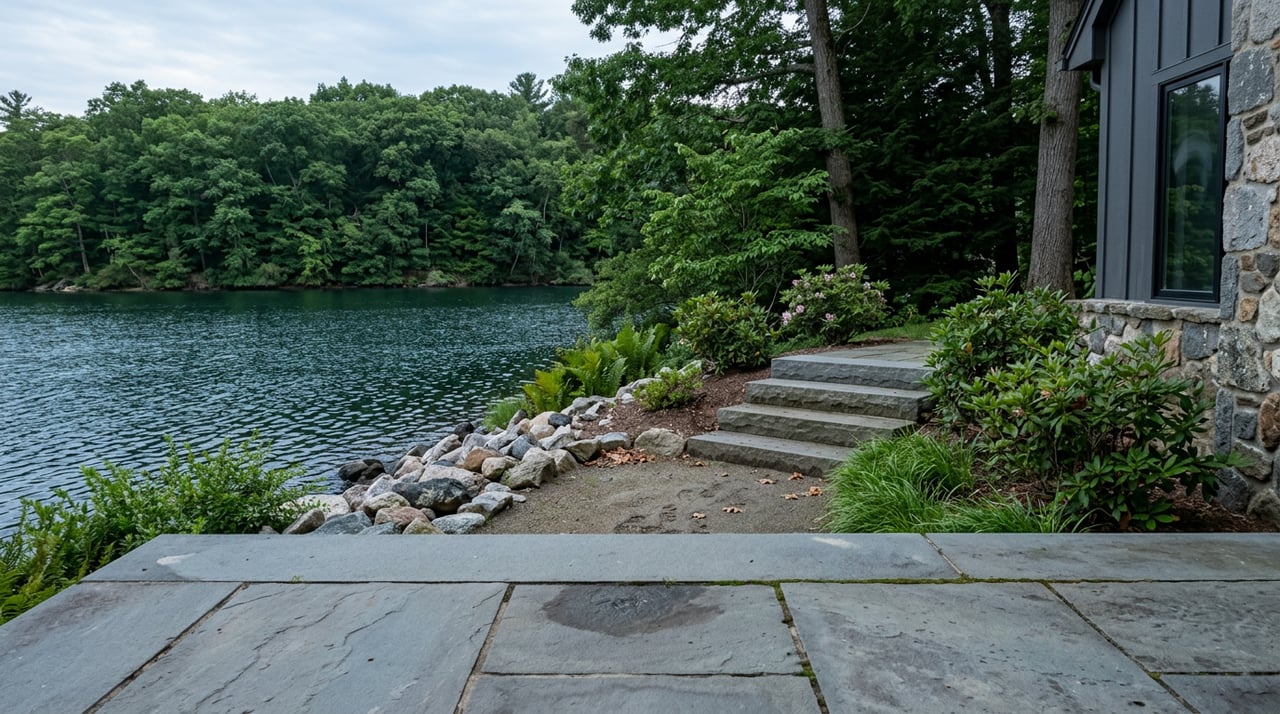
The view sells the house. The dock closes the deal, or blows it up at the inspection Duke Energy runs before your name goes on the permit. Buyers who write offers on Lake Keowee without answering one specific question about the existing dock almost always find that question waiting for them at transfer, and by then it belongs to them.
The question is simple. Whether it can be answered before you sign is not.
The Information Wall Duke Puts Between You And The Dock
Lake Keowee is not a public lake in the ordinary sense. Duke Energy owns or controls the lakebed and, in most tracts, an upland buffer strip, under the Keowee-Toxaway Hydroelectric Project license (FERC No. 2503). Every dock, boatlift, riprap wall, and covered slip sits on Duke's real estate under a revocable license held by the adjoining property owner. When you buy the house, you do not buy the dock. You buy the right to apply to have the license moved into your name.
Here is the part that catches buyers off guard. Duke Energy's Lake Services team will not provide permitting history to realtors, neighbors, former owners or potential buyers. Only the current permitted owner can request it. That means the seller has to pull the file for you, in writing, and you have to trust what comes back. If the seller is an estate, a distant heir, or an owner who inherited a dock the previous owner modified without a permit, the file may not tell the whole story. The story lands in full only at the transfer inspection, after the contract is signed.
What The Transfer Inspection Actually Checks
Applications to move a permit move through Duke's Lake Access Permit System, or LAPS. A Lake Services representative will inspect the facility to confirm it was properly permitted and has not been modified without Duke Energy's approval. If the Lake Services representative identifies noncompliance issues such as unauthorized changes to a structure, the applicant or current owner will likely be responsible for correcting the issue. "Applicant or current owner" is the phrase that matters. If the seller has already deeded the property to you, you are the current owner.
The inspection looks for the gap between the file and the physical structure. Common findings include:
- A roof or covered slip added after the last permit that pushes the total footprint over the 1,000 sq ft cap
- A dock box, storage bench, or cantilevered frame that changed the original footprint
- A boat lift or PWC lift installed without a modification permit
- Riprap or a seawall extended along the shoreline without a stabilization permit
- A walkway lengthened during a drought that now crosses the one-third-of-cove line
- Electrical or lighting upgrades that no longer meet Duke's standards
Any one of these can hold up a transfer until it is corrected, removed, or reapproved. Kroeger Marine and Master Docks, the two contractors most active on Keowee, both offer permit remediation as a routine service, which is a fair signal of how often it comes up.
The Rules A Dock Has To Live Inside
The permit rules themselves are less negotiable than buyers expect. Duke's published limits are the reason a seemingly generous dock can be out of compliance.
| Item | Duke Energy standard on Lake Keowee |
|---|---|
| Maximum private dock footprint | 1,000 sq ft including roof and walkway |
| Maximum walkway length | 120 ft, or 1/3 the distance across the cove, whichever is less |
| Boat slips | Up to 2 |
| PWC docks or lifts | Up to 2, in addition to the footprint cap |
| Permit validity | One year, non-renewable |
| Typical review timeline | 20 to 30 days, longer in spring and summer |
| Public access | Permits do not allow the lake neighbor to restrict public use of the lake or the shoreline |
The one-year, non-renewable clock is the second surprise. Dock permits issued by Duke Energy are valid for one year from the date of approval. They are not renewable; if the work is not completed within the permit period, a new application must be submitted. A seller who "has the permit approved" but never built is not selling you a dock. They are selling you a piece of paper that may already be expired, at which point you start over, at the current fee, in the current queue.
Why This Is A Keowee Problem, Not A Hartwell Problem
Buyers cross-shopping the two big lakes in this region tend to treat dock permitting as a formality on both sides. On Lake Hartwell, where the U.S. Army Corps of Engineers manages shoreline use, it more or less is. On Lake Keowee, it is not, because the shoreline is private-adjacent utility land under a federal hydroelectric license, and the licensee has both the incentive and the FERC obligation to enforce.
Within the past five years there has been significant interest in residential development along the Project shoreline of Lake Keowee. Large tracts of property have been purchased for development of residential communities along the entire shoreline of Lake Keowee. That pressure is exactly why Duke wrote a lake-specific Shoreline Management Plan for Keowee in the first place, and why the transfer inspection is not a rubber stamp.
Overlay the community rules and the picture gets tighter. Neighborhoods like The Cliffs at Keowee Vineyards and Keowee Key have their own Architectural Review Boards that can be stricter than Duke's baseline on dock style, materials, roof pitch, and whether a lot even qualifies for a private dock rather than a deeded slip at a community marina. Two lots on the same cove, sold for similar prices, can carry completely different dock rights.
On Keowee, dock eligibility is a property attribute, not a lake attribute. The waterfront lot next door may be dockable. Yours may not be, and no listing photograph will tell you which is which.
What To Do Before You Sign
The friction is real, but it is not a reason to walk away from a Keowee purchase. It is a reason to sequence the diligence differently than a buyer would on a non-regulated lake.
- Ask the seller, in writing, to request the full permit history from Duke Lake Services and provide the file to you before you go under contract. If they will not, treat that as data.
- Confirm the current dock tag is affixed and matches the permit on file. Duke tags structures at closeout inspection, and a missing tag is a flag.
- Have your surveyor or a knowledgeable dock contractor measure the actual dock, walkway, and any covered area against the permitted dimensions. Contractors on Keowee do this routinely.
- If the lot is in a covenanted community, pull the ARB file on the dock separately. Duke does not enforce private covenants, and private covenants do not defer to Duke.
- Add a dock-permit-transfer contingency to your contract. Give it real teeth: a right to terminate if Duke's transfer inspection identifies noncompliance costing more than a stated dollar figure to cure.
- Budget for the transfer application through LAPS and the possibility of a small delay between closing and permit issuance. Duke does not accept digital signatures on the User's Agreement, and paperwork moves at paper speed.
For a lot without an existing dock, run the same diligence in reverse. Confirm in writing, from Duke, that the shoreline classification, water depth, and cove geometry allow a permittable dock at the location you have in mind. "Waterfront" and "dockable" are not the same word on this lake.
FAQ
Does the dock permit transfer automatically at closing? No. The property transfers by deed. The dock permit is a separate revocable license from Duke Energy, applied for through LAPS, contingent on a Lake Services inspection of the existing structure.
What happens if Duke finds an unpermitted modification after I close? Correction becomes the responsibility of the applicant or the current property owner. Options are typically to remove the noncompliant element, modify it to conform, or apply for a new permit that captures the current footprint if the rules allow.
Can I keep boating while the transfer is pending? Unless otherwise posted by Duke Energy, the water and shoreline of Duke Energy's hydro lakes is available for public recreation including boating, swimming, fishing and wading. Using the water is not the same as holding a dock permit, and unauthorized modifications during the transfer window will surface at inspection.
Ready To Look Past The View
A Lake Keowee purchase is a good decision made from clear information. The dock permit is where clear information is hardest to get, which is exactly why it belongs at the front of the process rather than the back. Cooper Dalrymple works Keowee buyers through the Duke Lake Services file, the community ARB layer, and the transfer inspection before the contract is signed, so the dock you thought you were buying is the dock you actually own.
Be the First to See It.