You see “deep-water dock” on a Lake Keowee listing and wonder what it really guarantees. You want year-round access for your boat, not surprises when lake levels shift. In this guide, you’ll learn how “deep-water” is used in our local market, what affects usable depth, how dock types differ, and how to verify claims before you write an offer. Let’s dive in.
What “deep-water” really means on Lake Keowee
“Deep-water” is a marketing term, not a regulated designation. On Lake Keowee, sellers use it to suggest that the water at the dock stays usable for boating and swimming through normal lake level changes. In practice, it points to fewer restrictions at typical operating levels and better clearance for larger boats.
For you as a buyer, read “deep-water” as “sufficient depth for your boats and activities given the lowest expected lake elevation.” That last part matters. Your needs will differ if you run a pontoon versus a wake boat, and if levels dip seasonally or for maintenance.
Why it matters for buyers in 29691
A mismatch between the label and real conditions can lead to frustration and cost. A dock that works great at high pool may be marginal at low pool, especially in a sloped cove. Properties with reliable, deeper access usually attract more demand and can command a premium. The exact value impact should be grounded in local comparables in Oconee County and around 29691.
How Lake Keowee water levels change
Lake Keowee is a reservoir managed by Duke Energy for hydropower and cooling. Their operational needs drive short-term and seasonal level changes. You can expect several types of fluctuations:
- Short-term operational shifts that can move levels over days or weeks.
- Planned drawdowns for maintenance or infrastructure work.
- Seasonal and drought variability that can lower levels for extended periods.
What you should verify:
- Historical range. Ask for recent high and low levels tracked by Duke Energy and local associations.
- Scheduled work. Check for upcoming maintenance or drawdowns that could affect access.
- Timing of your visit. Try to inspect and measure depth at or near normal pool, and if possible during a seasonal low that reflects real-world conditions.
Local associations and marina operators can share how level changes impact specific coves and channels. Use their practical insight as a complement to official notices.
Dock types and depth needs
Different docks interact with changing levels in different ways. Knowing the type on a property helps you judge the depth you’ll need for reliable use.
- Floating docks. These rise and fall with the water. They handle variability well but still require adequate depth for your boat at low pool.
- Fixed or pile docks. These are supported by pilings and feel stable in wakes and storms. They demand deeper water where the pilings sit and can be more constrained at low levels.
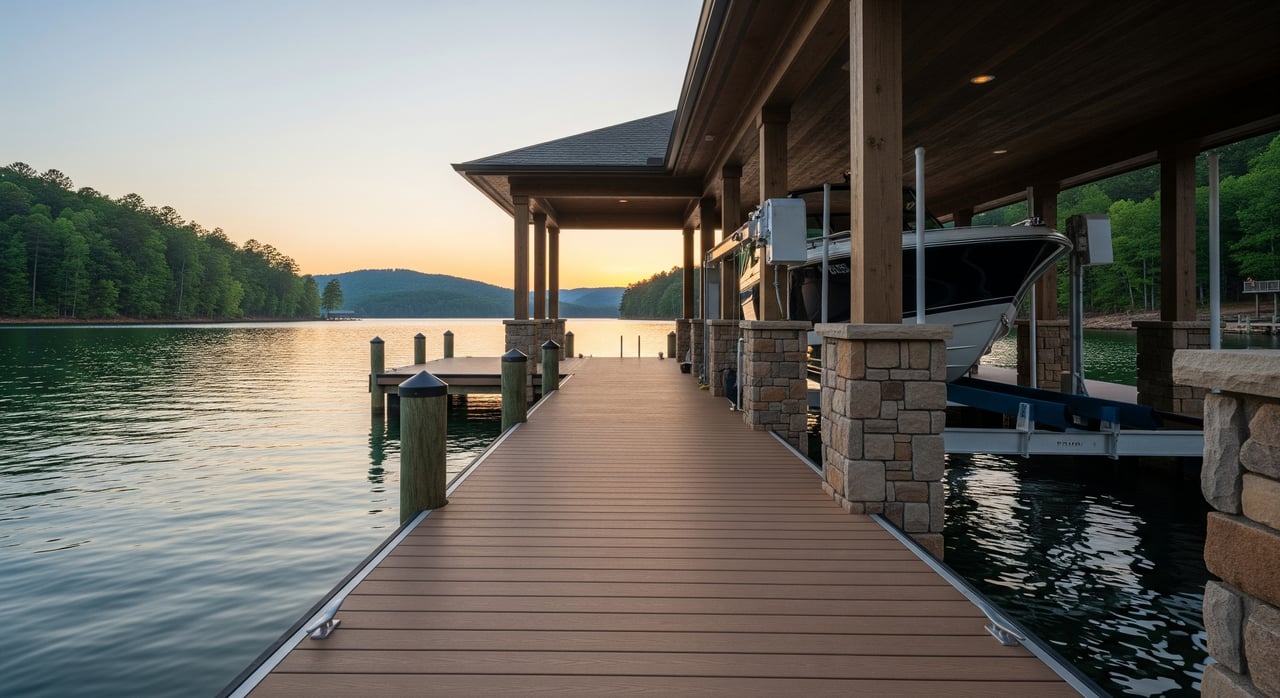
- Covered boathouses and lifts. Useful for protection and keeping boats out of the water, but lifts need more depth to operate correctly.
- PWC docks and small ramps. Often usable in shallower water, but still need safe clearance at the lowest expected levels.
Typical boat and lift depth ranges
These are general ranges to guide your evaluation, not guarantees. Always check measured depth at representative low levels.
- Small fishing boats, jon boats, PWCs: often fine with shallower water under about 3 feet of draft, with safe clearance at low pool.
- Pontoons and family runabouts: commonly need consistent mid-range depth, and many owners look for roughly 3 to 4 feet at low pool.
- Wake boats, ski boats, larger cruisers: usually need more room for maneuvering and prop clearance, often 4 to 6+ feet at low levels.
- Boat lifts and covered slips: lifts add vertical travel and clearance needs that can push minimum depth higher, especially at low pool.
How to verify a “deep-water” claim
You do not have to guess. A few practical steps will give you clarity before you commit.
- Measure depth at the dock. Request a recent reading at typical low elevations. If possible, have a marina contractor or surveyor get a fathometer reading at the slip and turning area.
- Check during a low period. If there is a scheduled drawdown or known seasonal low, plan your visit then.
- Match depth to your boat. Consider your boat’s loaded draft, the lift’s travel needs, and safe turning room near the slip.
- Inspect navigation paths. Look for narrow channels, rocks, or submerged hazards that could compromise otherwise adequate depth.
- Ask the seller about real use. What boats have they kept there? Have they had to move or remove a boat during low water? Were there lift issues at low pool?
Permits and shoreline rules in Oconee County
Duke Energy controls shoreline permitting on Lake Keowee. Most docks, boathouses, and similar structures require their approval under the lake’s shoreline management program. County permits may also apply, and private covenants or HOAs can add design and setback rules.
What to ask for and confirm:
- Duke Energy documentation. Request the dock’s permit or license number and a copy of the approval. Confirm the structure’s compliance status and whether the permit is transferable.
- County approvals. Check for Oconee County building or zoning permits and verify any required setbacks, septic separations, or floodplain compliance.
- Design details. Review the site plan, survey showing the high-water line, and dock drawings. In some cases, ecological assessments may be part of the file.
- Future changes. If you plan to add a lift or replace the dock, consult Duke Energy about current policies, size limits, and setbacks before you buy. Timelines and fees vary; local marinas and contractors can share typical timeframes.
Buyer checklist for Lake Keowee docks
Use this to compare listings in 29691 and across Oconee County.
- Physical facts
- Recent survey showing high-water mark and dock placement.
- Depth reading at the slip and turning basin at typical low pool.
- Professional evaluation of dock condition, piling depth, and lift operation.
- Legal and permit facts
- Duke Energy permit/license number and any county permits, with copies.
- Any shared dock agreements, riparian rights documentation, or easements.
- Operational usability
- Boat types historically used at the dock and any seasonal limitations.
- Clear navigation route from the dock to open water without hazards.
- Long-term risk and costs
- Expected maintenance for the dock, pilings, and lifts.
- Insurance considerations for waterfront structures.
- Market impact based on local comparables with similar water access.
How depth can affect value
Deeper, reliable access often boosts buyer interest. That said, the premium depends on neighborhood comparables, the dock’s quality and configuration, and the home’s overall features. The best way to gauge value in 29691 is to compare recent sales with documented depth and similar shoreline conditions. A local, lake-focused broker can help you quantify the spread and negotiate with confidence.
Plan your purchase with confidence
When you see “deep-water dock” on a Lake Keowee listing, think usability at low pool and match it to your boat and lifestyle. Measure, document, and confirm permits. If you want a seamless path from choosing a lot or home to improving the dock or adding a lift, you benefit from a team that pairs lakefront brokerage expertise with in-house construction. If you are comparing listings in 29691 or planning a custom build on Keowee, let us help you verify the details that matter and move forward without doubt.
Ready to explore Lake Keowee with a local, builder-backed advisor? Connect with Cooper Dalrymple to get tailored guidance and be the first to see the right opportunities.
FAQs
On Lake Keowee, is “deep-water” guaranteed year-round?
- No, levels are managed by Duke Energy and year-round usability depends on depth at low pool and any drawdowns, so verify measured depths and recent level history.
Do you need a Duke Energy permit for an existing dock on Keowee?
- Most docks require Duke Energy approval, so ask for the permit or license, check its status, and confirm whether it is transferable with the property.
Will a wake boat or cruiser work at a “deep-water” dock in 29691?
- Possibly, but you should confirm low-pool depth, lift operation, and safe turning room against your boat’s draft and local navigation constraints.
Does deeper water always mean a higher sale price in Oconee County?
- Deeper, reliable access often increases desirability, but the premium depends on local comps, dock quality, and the property’s overall features.